
Privacy-First Surveillance: Radar's Rise
The growing backlash against traditional camera-based surveillance due to privacy concerns and data regulations like GDPR and CCPA has created an urgent need for alternatives. Imaging radar emerges as a powerful, privacy-preserving solution, offering robust security monitoring without collecting personally identifiable information, fundamentally changing how sensitive environments can be protected.
Privacy-First Surveillance: How Imaging Radar Reimagines Security
In an increasingly connected world, the tension between security and individual privacy has reached a critical juncture. For decades, camera-based surveillance has been the go-to solution for monitoring public spaces, critical infrastructure, and private facilities. However, the omnipresence of cameras, coupled with advancements in facial recognition and AI analytics, has ignited a fervent backlash, challenging the very foundation of traditional security paradigms.
From city halls banning facial recognition to stringent data protection regulations, the demand for privacy-by-design security is no longer a niche request but a mainstream imperative. This shift is paving the way for innovative technologies, and among them, 4D imaging radar stands out as a transformative force, offering robust, all-weather security without compromising the fundamental right to privacy.
The Privacy Problem with Cameras: A Growing Backlash
Cameras are powerful tools. They capture high-resolution visual data, enabling detailed identification and forensic analysis. But this strength is also their Achilles' heel in the privacy debate. Every pixel captured by a camera can potentially identify an individual, record their activities, and even infer sensitive personal information.
Regulatory Pressure and Public Outcry
GDPR and CCPA: The General Data Protection Regulation (GDPR) in Europe and the California Consumer Privacy Act (CCPA) in the United States, among others, have set a global standard for data privacy. They impose strict rules on the collection, processing, and storage of personal data, including images. Non-compliance can lead to hefty fines and reputational damage.
Facial Recognition Bans: Several major U.S. cities, including San Francisco, Boston, and Oakland, have banned or severely restricted the use of facial recognition technology by law enforcement and government agencies. These bans reflect a widespread public concern about civil liberties, potential for misuse, and algorithmic bias.
Ethical Concerns: Beyond legal frameworks, there's a growing ethical debate about pervasive surveillance. The idea of being constantly monitored, with data potentially used for profiling or discriminatory purposes, erodes public trust and fundamental freedoms.
For organizations, this creates a dilemma: how to maintain robust security operations while adhering to evolving privacy laws and public expectations? The answer lies in moving beyond technologies that inherently collect personally identifiable information (PII) as their primary data output.
Enter Imaging Radar: Security Without Identity
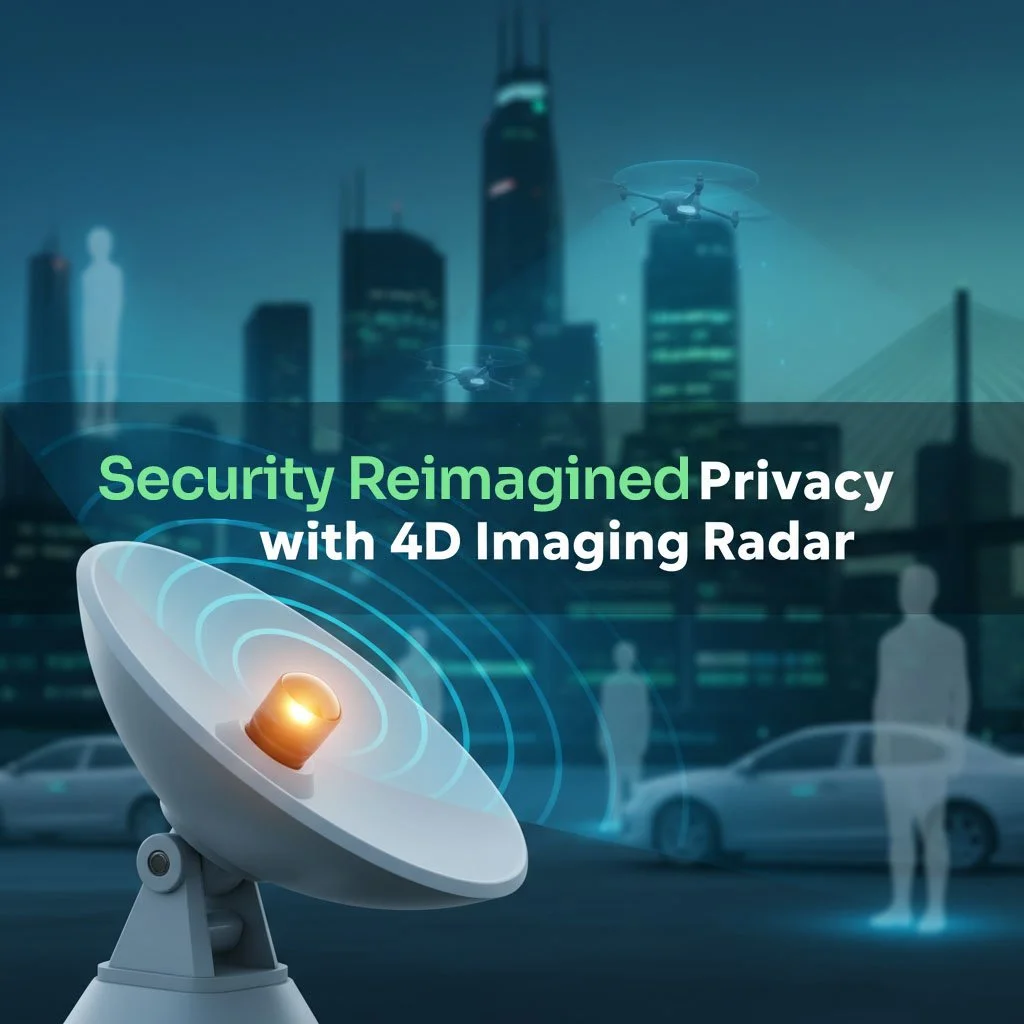
This is where 4D imaging radar offers a groundbreaking alternative. Unlike cameras, radar does not 'see' in the visual spectrum. Instead, it emits radio waves and analyzes the reflections to detect targets, measure their range, velocity, and elevation. The output is a dense 4D point cloud – a representation of objects and their movement in space – not a high-resolution image of a person’s face or clothing.
How Radar Ensures Privacy-First Surveillance
Zadar Labs' Software-Defined 4D Imaging Radar (SDIR) technology embodies this privacy-first approach:
No PII Collection: Radar intrinsically does not collect visual data that can be used for facial recognition or individual identification. It detects the presence, movement, and general form of objects – whether they are people, vehicles, or animals – without capturing any biometric or identifying features.
Object Detection, Not Identification: A radar system can accurately track multiple targets within a designated area, distinguish between humans, vehicles, and other moving objects, and provide precise positional and velocity data. It can alert security personnel to an intruder in a restricted zone, but it won't tell them the intruder's eye color or brand of clothing.
All-Weather Reliability: Beyond privacy, radar offers superior performance in adverse conditions where cameras fail. Fog, heavy rain, snow, dust, smoke, and complete darkness have virtually no impact on radar's ability to detect and track. This ensures continuous, reliable security monitoring 24/7, regardless of environmental challenges.
Dense 4D Point Clouds: Modern 4D imaging radar generates incredibly rich point clouds, providing not just 2D position but also elevation and instantaneous velocity. This allows for sophisticated behavioral analysis (e.g., distinguishing between a person walking and crawling, or a vehicle approaching at high speed) without ever needing to identify the individual.
Reduced False Alarms: By accurately classifying targets and tracking their movement in 4D, radar systems can significantly reduce the false alarms that plague camera-based or simpler sensor systems, which are often triggered by environmental factors like shadows or moving foliage.
Applications: Where Privacy-First Radar Excels
The unique combination of robust detection and inherent privacy makes imaging radar an ideal solution for a multitude of security-sensitive environments:
1. Critical Infrastructure & Perimeter Security
Airports, ports, power plants, data centers, and military bases require uncompromising security around their perimeters and within their grounds. Radar can provide:
Early Intrusion Detection: Long-range radar can detect unauthorized personnel or vehicles approaching a perimeter long before they pose a direct threat, even in complete darkness or harsh weather conditions.
Non-Invasive Monitoring: Secure facilities can monitor staff and operations indoors or outdoors without raising privacy concerns among employees or visitors. Alerts are generated based on anomalous behavior (e.g., loitering in restricted zones), not on identifying individuals.
Cost-Effective Wide Area Coverage: A single radar unit can cover vast areas with high precision, often reducing the number of sensors and associated infrastructure compared to camera-based systems.
2. Smart Cities & Urban Planning
Cities are increasingly adopting sensor technologies to manage traffic, optimize public transport, and enhance public safety. Privacy is paramount in these applications.
Traffic Flow Monitoring: Radar can accurately count vehicles, determine speeds, detect congestion, and classify vehicle types without recording license plates or driver identities. This provides valuable data for urban planning and traffic management.
Pedestrian Safety: Monitoring pedestrian crossings and high-traffic areas for potential conflicts with vehicles, all while respecting individual privacy.
Occupancy & Space Utilization: In public buildings or parks, radar can assess occupancy levels or crowd density without needing to identify individuals, optimizing resource allocation and managing public safety.
3. Industrial Automation & Robotics
Manufacturing facilities, warehouses, and logistics hubs increasingly rely on autonomous mobile robots (AMRs) and automated systems. Human-robot collaboration requires reliable, safe, and privacy-respecting sensing.
Worker Safety Zones: Radar can create virtual safety perimeters around dangerous machinery, alerting when a human enters a hazardous area without recording their activity.
Collision Avoidance: Equipping AMRs with radar ensures robust obstacle avoidance in dynamic, often dusty or visually challenging, industrial environments, protecting both personnel and valuable assets.
4. Healthcare & Eldercare
The need for discreet monitoring in sensitive environments like hospitals, care homes, or even private residences is growing, especially for fall detection and patient safety.
Privacy-Preserving Monitoring: Radar can detect falls or prolonged immobility in a room without cameras, ensuring the dignity and privacy of patients and residents.
Bed Occupancy & Activity Monitoring: Track movement patterns or bed occupancy without intrusive visual recording, offering an unobtrusive way to ensure well-being.
The Zadar Labs Advantage: Software-Defined 4D Imaging Radar
Zadar Labs' approach to 4D imaging radar is not just about hardware; it's about a flexible, software-defined architecture that unlocks unprecedented capabilities and adaptability.
Configurability: Our software-defined radar can be reconfigured over-the-air to adjust range, field of view, resolution, and detection parameters, enabling a single platform to serve diverse applications with optimal performance.
Multi-Vertical Capability: While many competitors focus almost exclusively on automotive, Zadar Labs' SDIR is designed for broad applicability across security, robotics, agriculture, smart cities, and industrial sectors. This versatility allows system integrators to leverage a proven technology in new and emerging markets.
Sensor Fusion Ready: While radar provides a complete sensing picture on its own, its data seamlessly integrates with other sensor modalities (like thermal cameras for visual verification post-alert) to create the most comprehensive and privacy-aware security solutions.
Conclusion: A New Era of Responsible Security
The tide has turned against pervasive camera-based surveillance in many corners of the world. As regulatory landscapes evolve and public awareness of data privacy intensifies, security solutions must adapt. Zadar Labs is at the forefront of this transformation, championing 4D imaging radar as the technology that delivers uncompromising security while inherently protecting individual privacy.
For security directors, CSOs, city planners, and system integrators, the time is now to embrace privacy-first principles. By deploying intelligent, software-defined 4D imaging radar, organizations can build robust, future-proof security infrastructures that safeguard assets, ensure public safety, and uphold the fundamental right to privacy, all without compromise.
