
Radar vs. LiDAR: Sensing the Future, Rain or Shine
TL;DR
4D imaging radar maintains full sensing capability in weather conditions that severely degrade LiDAR. For mission-critical autonomous systems, this weather resilience is essential for real-world deployment.
In the rapidly evolving landscape of autonomous systems, robotics, and advanced security, precise and reliable environmental perception is paramount. Two prominent technologies stand at the forefront of this perception challenge: LiDAR (Light Detection and Ranging) and Radar (Radio Detection and Ranging). While both serve to map an environment and detect objects, their fundamental operating principles lead to distinct performance characteristics, particularly when faced with adverse weather conditions.
What is LiDAR?
LiDAR is an active sensing technology that uses pulsed laser light to measure distances to targets. The principle is analogous to radar, but instead of radio waves, it employs light waves, typically from the infrared spectrum. A LiDAR system emits rapid pulses of laser light, and a sensor measures the time it takes for each pulse to return after reflecting off an object. By calculating the 'time-of-flight' (ToF) for millions of these pulses per second, LiDAR constructs a highly detailed, 3D point cloud map of its surroundings. Each point in the cloud represents a measured distance and angle, creating a rich spatial representation.
Key characteristics of LiDAR:
High Resolution: LiDAR is renowned for its exceptional angular resolution, capable of generating incredibly dense and accurate 3D point clouds, ideal for object shape recognition and precise mapping.
Direct Depth Measurement: It directly measures distance, providing accurate depth information without complex algorithms.
Detailed 3D Mapping: Excellent for creating detailed topographical maps and understanding complex scene geometry.
Radar vs. LiDAR: Fundamental Differences
While both technologies are essential for environmental perception, their underlying physics dictate their strengths and weaknesses:
1. Wavelength and Medium Interaction
LiDAR (Light): Operates using electromagnetic waves in the visible or near-infrared spectrum (wavelengths typically from 905nm to 1550nm). These shorter wavelengths result in high angular resolution but are significantly attenuated by atmospheric particles.
Radar (Radio): Utilizes electromagnetic waves in the radio or microwave spectrum (wavelengths typically from millimeters to centimeters). These longer wavelengths are far less susceptible to scattering and absorption by water droplets, fog, dust, and snow.
2. Resolution and Data Output
LiDAR: Provides extremely dense 3D point clouds with high angular resolution, allowing for precise object shape identification and detailed scene reconstruction. However, it struggles to directly measure an object's velocity.
Conventional Radar: Historically offered lower angular resolution, providing sparse point data. However, it inherently measures object velocity (Doppler effect) with high precision, which LiDAR cannot do directly. Modern 4D imaging radar, like Zadar Labs' offerings, bridge this resolution gap, providing high-resolution 3D point clouds with integrated velocity.
3. Environmental Robustness
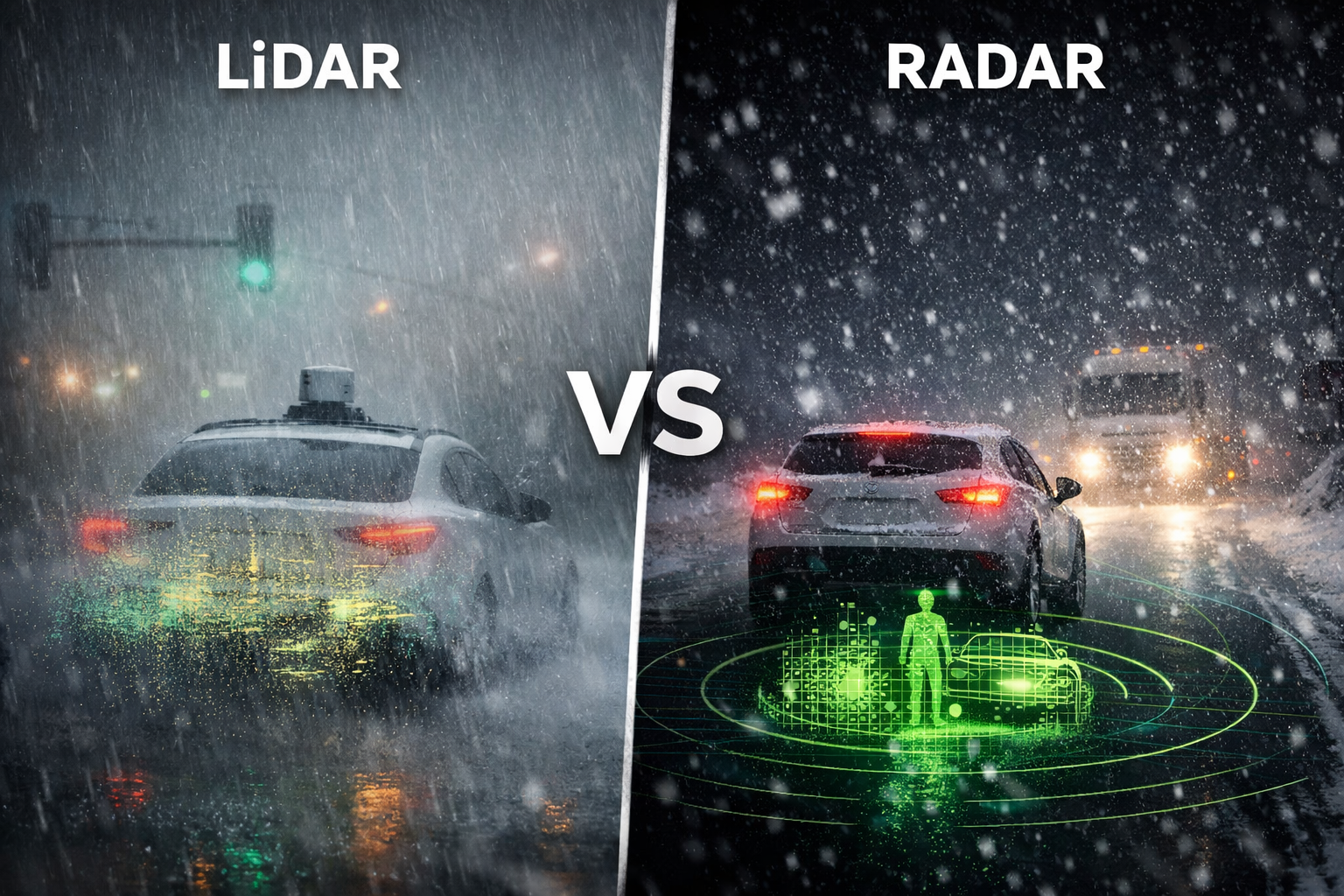
LiDAR: Its performance degrades significantly in adverse weather conditions such as heavy rain, fog, snow, and even direct sunlight (which can saturate its sensors). The laser light scatters off water particles, leading to signal loss and inaccurate readings.
Radar: Exhibits excellent penetration capabilities through most atmospheric conditions. The longer radio waves can pass through rain, fog, and snow with minimal attenuation, ensuring consistent performance regardless of visibility.
4. Cost and Power
LiDAR: High-resolution LiDAR systems can be expensive due to complex optical and mechanical components (especially spinning LiDARs). Solid-state LiDAR is emerging but still faces cost and performance trade-offs.
Radar: Generally more cost-effective, especially with advancements in solid-state radar technology. Power consumption can vary, but modern designs are increasingly efficient.
The All-Weather Advantage: Why Radar Excels Where LiDAR Fails
The starkest differentiator between Radar and LiDAR, and a critical factor for safety-critical applications, is their performance in challenging environmental conditions. Autonomous vehicles, security systems, and industrial robotics cannot afford to be blinded by a sudden downpour, a thick fog, or a snowstorm.
Here's why radar offers a decisive advantage:
Rain Penetration: Radio waves are largely unaffected by raindrops, which are much smaller than their wavelength. In contrast, laser beams from LiDAR scatter off raindrops, creating noise and reducing the useful signal.
Fog/Mist Penetration: Fog consists of tiny water droplets. While dense fog can affect radar slightly, its impact is minimal compared to the near-total blindness it induces in LiDAR systems.
Snow Penetration: Similar to rain and fog, snow poses little challenge to radar. LiDAR, however, sees snow as a multitude of reflective surfaces, generating chaotic point clouds and obscuring actual objects.
Dust and Smoke: Industrial environments often contain dust or smoke. Radar maintains its perception capabilities, whereas LiDAR's performance is severely compromised.
Direct Sunlight: LiDAR can experience performance degradation or even saturation from direct sunlight, especially when the sun is low on the horizon, as the ambient light can interfere with the laser signal reception. Radar is immune to light conditions.
Zadar Labs' zPRIME 3.0: Redefining Radar Performance
While traditional radar had limitations in angular resolution, Zadar Labs' 4D imaging radar technology fundamentally redefines what radar can achieve. Our zPRIME 3.0 is a testament to this engineering excellence, offering a compelling alternative and complementary solution to LiDAR.
What makes zPRIME 3.0 better than other radars?
Unprecedented 4D Resolution: zPRIME 3.0 generates high-resolution 4D point clouds (X, Y, Z, and Velocity) for every detected point. This means not only accurate spatial information but also precise real-time velocity data for every object, crucial for predicting trajectories and avoiding collisions.
Software-Defined Architecture: Our proprietary software-defined radar (SDR) architecture allows for unparalleled flexibility and adaptability. Unlike fixed-function hardware, zPRIME 3.0 can be optimized and reconfigured through software updates, extending its lifespan and enabling new capabilities without hardware changes. This allows for dynamic waveform shaping, adaptive beamforming, and advanced processing algorithms that other radars simply cannot achieve.
Advanced Array Processing: Leveraging sophisticated MIMO (Multiple-Input, Multiple-Output) antenna arrays and advanced signal processing algorithms, zPRIME 3.0 achieves angular resolution that rivals, and in some aspects surpasses, traditional high-end LiDARs while maintaining radar's inherent all-weather robustness.
Robust Object Detection & Classification: The combination of high-resolution 4D data and Zadar Labs' cutting-edge AI/ML perception stack enables superior object detection, tracking, and classification – even in complex and challenging environments.
Long Range and Wide Field of View: zPRIME 3.0 offers an extended detection range and a wide field of view, providing comprehensive environmental awareness crucial for high-speed applications and large-area surveillance.
Compact and Cost-Effective: Despite its advanced capabilities, zPRIME 3.0 is designed for practicality – leading to a compact form factor and a sustainable cost structure, making it a viable option for widespread deployment across various industries.
The Future is All-Weather, All the Time
While LiDAR undeniably offers exceptional resolution in ideal conditions, its vulnerability to atmospheric interference presents a significant limitation for safety-critical and always-on applications. Radar, with its inherent all-weather capabilities, emerges as the more resilient and dependable sensing modality. Zadar Labs' zPRIME 3.0 revolutionizes radar performance, offering LiDAR-like resolution and detail, but critically, maintaining peak performance in conditions where LiDAR systems falter.
For system integrators, engineering decision-makers, and security operators, the choice is clear: robust, all-weather perception is non-negotiable. Zadar Labs' 4D imaging radar provides the confidence and reliability needed to unlock the next generation of autonomous and intelligent systems, ensuring operations continue, rain, fog, or shine.
