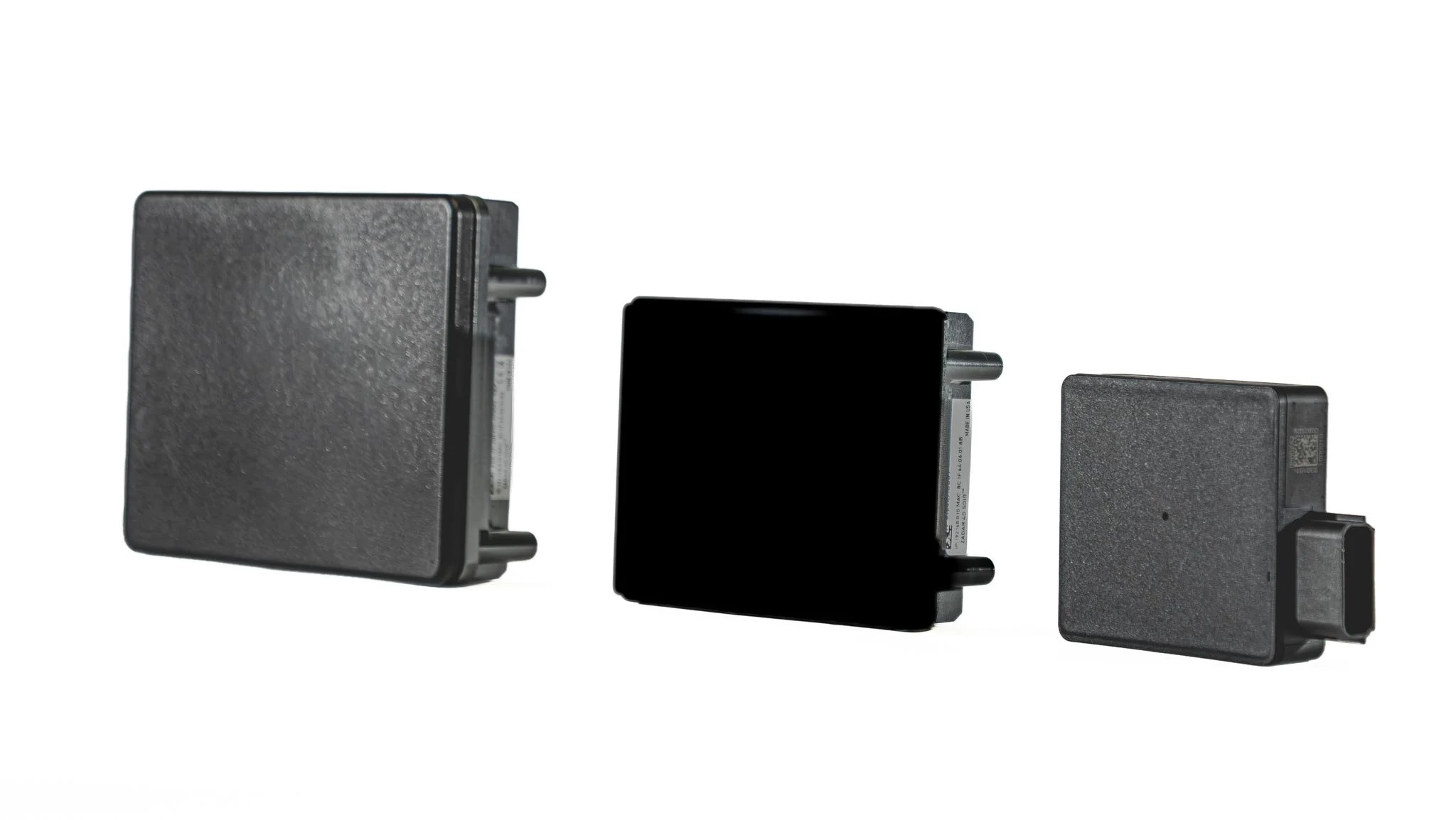
Hardware
Hardware
Three sensors. One radar platform, one software stack, one integration you only learn once.
Every Zadar 4D imaging radar outputs the same point cloud — range, azimuth, elevation, Doppler — through the same APIs, the same SDKs, and the same software layers. What changes between them is reach, coverage, and size. Choose by the shape of the scene you need to see, not by relearning a platform.
zPRIME
zPRIME
zPULSE · zPRIME UW
zPULSE
The sensors
What each one is actually for.
Three sensors, three jobs — reach, coverage, or footprint. Most requirements make the choice obvious once you know which of those three you are optimising for.
zPRIME
Long-range · ultra-high resolution
- Field of view
- 120° × 24–90°
- Angular resolution
- 0.35°
- Angular accuracy
- ±0.05°
- Car detection
- > 800 m
- Weight
- 520 g
zPULSE
Mid-range · compact
- Field of view
- 120° × 90°
- Angular resolution
- 1.5°
- Angular accuracy
- ±0.25°
- Car detection
- > 400 m
- Weight
- 200 g
zSIGNAL
Development & research platform
- Field of view
- Pending
- Angular resolution
- Pending
- Angular accuracy
- Pending
- Car detection
- Pending
- Weight
- Pending
Compare
Side by side, no marketing in the cells.
zPRIME is shown with its long-range antenna. Its wide and ultra-wide antennas widen vertical coverage to 50° and 90° at shorter range — the full breakdown is on the product page. Detection ranges assume obstruction-free real-world conditions at over 90% detectability.
| Specification | zPRIME Long range | zPULSE Mid-range · compact | zSIGNAL Development platform |
|---|---|---|---|
| Coverage & resolution | |||
| Field of view, H × V | 120° × 24° | 120° × 90° | Pending |
| Static angular resolution | 0.35° × 0.4° | 1.5° | Pending |
| Angular accuracy | ±0.05° | ±0.25° | Pending |
| Detection range | |||
| Truck detection | > 1,000 m | > 400 m | Pending |
| Car detection | > 800 m | > 400 m | Pending |
| Human detection | > 180 m | > 200 m | Pending |
| Physical | |||
| Dimensions | 140 × 104 × 35 mm | 80 × 70 × 40 mm | Pending |
| Weight | 520 g | 200 g | Pending |
| Sealing | IP68, 2 m | IP68, 2 m | Pending |
| Software & integration | |||
| 4D point cloud output | Yes | Yes | Yes |
| RSP Core included | Yes | Yes | Yes |
| Python, C++, ROS 1 / ROS 2 | Yes | Yes | Yes |
Electrical, interface, certification and environmental specifications are listed in full on each product page. "Pending" marks a figure not yet published here.
In short: zPRIME is the long-range, high-resolution sensor — 0.35° static angular resolution, ±0.05° accuracy, and truck detection beyond 1,000 m on its long-range antenna, in a 520 g housing. Choose it when reach or target separability decides the application.
zPULSE covers a full 120° × 90° field of view with 400 m car and truck detection at 200 g and 80 × 70 × 40 mm. Choose it when mass, volume, or near-hemispherical coverage decides the application.
Both are IP68-sealed, both output a 4D point cloud with range, azimuth, elevation and Doppler, and both ship with RSP Core plus Python, C++, ROS 1 and ROS 2 support — so moving between them costs integration time, not a new platform.
Use cases
What people are actually building with these.
Each card names the sensor we would start from. None of them is a hard rule — mounting height, coverage area, and weather all move the answer.
Highway ADAS & autonomous driving
Long, shallow scenes where the decision has to be made before the target is close. Needs reach, and the resolution to tell a motorcycle from the truck beside it.
Start with zPRIME long range
Traffic management & smart infrastructure
Intersections and corridors where vertical extent matters as much as depth, and where dozens of radars may run within a few hundred metres of each other.
Start with zPRIME wide FOV
Drones & aerial platforms
Obstacle avoidance and altitude above terrain, where every gram costs endurance and the sensor has to see almost hemispherically.
Start with zPULSE
Heavy equipment & machine safety
360° awareness around excavators, haul trucks, and autonomous machines, in the dust and darkness that defeat cameras and lidar outright.
Start with zPULSE
Perimeter security & wide-area surveillance
Mast-mounted coverage of a site boundary, tracking every mover across a wide arc so cameras only have to look where something is happening.
Start with zPRIME wide FOV
Research & radar development
Programmes that need to get underneath the production interface — raw data, custom waveforms, and sensing modes that do not exist yet.
Start with zSIGNAL
Still deciding
Send us the scene, not the spec sheet.
Mounting height, coverage area, weather, and the smallest thing that has to be detected before it matters. Give us those four and we will tell you which sensor fits — and whether radar is the right answer at all.
Frequently Asked Questions
Questions we get from engineers evaluating this sensor.
-
Start with the scene, not the range figure. LR (120° × 24°) suits long, shallow scenes, highways, haul roads, approaches. W (120° × 50°) suits intersections and yards where vertical extent matters. UW (120° × 90°) suits close-quarters awareness on drones and equipment working near people. Send us your mounting height and coverage area and we'll recommend one.
-
On real-world targets, not corner reflectors. It's the measured angular separability between two targets with SNR of 5 dB or better occupying the same range-Doppler cell, the hardest case, and the one that matters, because it's where conventional radar merges two objects into one detection.
-
Yes. Component pages carry recorded detection footage, and we run live demonstrations with real sensors on request — including with your target scenario where we can arrange it. Get in touch and tell us what you need to see.
-
The Core software tier ships with every zPRIME 3.0 and includes point cloud output, the configuration API, SDKs, and the web visualizer — enough to integrate the sensor entirely on your own stack. Peak performance comes from pairing the radar with zVUE in Full-Stack SDIR mode, where context-aware feedback informs the radar's own operation.
-
Yes. zVUE works with any 4D radar in Partial SDIR mode, connected radar fusion, data conditioning, and pre-perception libraries improve system performance on existing hardware. Full-Stack SDIR mode, which requires Zadar sensors, is where the closed loop between software and waveform delivers the full result.
-
Interference rejection is a core design goal rather than a mitigation added afterward. Null steering suppresses jammers and in-band interference, and detection holds with up to 20 nearby active radars, tested to ISO 17387. In our architecture, improving detection and improving interference resistance are the same work.
-
77 GHz radar propagates through airborne particulates and precipitation that scatter light, so performance degrades far more gracefully than lidar or cameras. The housing is IP68-rated to 2 m and qualified from −40 °C to +85 °C with thermal cycling, shock, and vibration testing to EN 60068 and ISO 16750.
-
No. Commercial 60 and 77 GHz radars have been in safe use for years and manufacturers work within strict transmit-power limits. This is low-power, surface-reflecting sensing — not military or marine radar. zPRIME 3.0's detection range comes from highly sensitive receivers and SDIR system optimization, not high transmit power.
-
The platform is solid-state with no moving parts, automotive-grade, and built for harsh low-maintenance environments. Certification covers FCC Part 95M, CE, MIC (Japan), and KC (South Korea), with environmental qualification to EN 60068 and ISO 16750.
-
Both are possible. The array architecture supports horizontal field-of-view expansion to 160°, and custom operational modes can push maximum instrumented range beyond the published figures. Each is an engineering conversation rather than a catalogue option — tell us the requirement.
-
One cable and the web interface gets you a live point cloud. From there: HTTP API for configuration, UDP with Protobuf for data, Python and C++ SDKs, and ROS 1 / ROS 2 packages. IEEE 1588 PTP timestamping and sync-frame triggering handle multi-sensor coherence.
-
Depends on configuration and volume. Contact sales for current availability.
Tell us what you need to see.
Send us the scene, the mounting height, the coverage, the weather, the thing that has to be detected before it matters. We'll tell you which configuration fits, and whether radar is the right answer at all.